Back to News

BPOAI News / AI Vendors & Tools

Tree Work Is Getting a New Set of Eyes. LiDAR Will Save You Money.

A Melbourne arborist is building a custom CRM and LiDAR-style tree scanning with LYRIQ.AI. Here is what it means for your time, your money and your peace of mind.

Share on LinkedIn
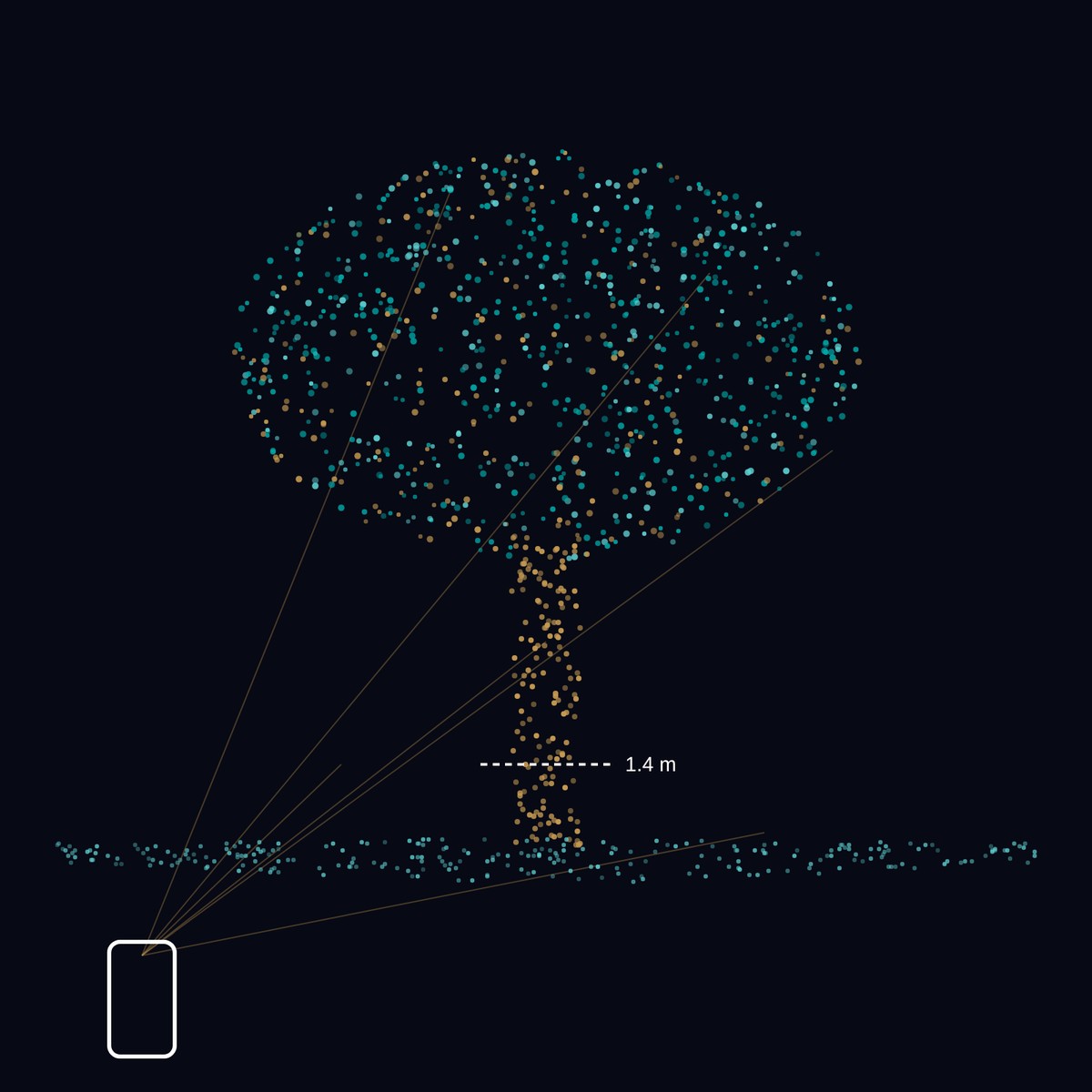
A tree as a LiDAR scan sees it: thousands of measured points Graphic: BPO AI Editorial Team

Walk onto any building or landscaping job and count the people measuring the same patch of ground. Owner. Designer. Builder. Landscaper. Arborist. Certifier. Council.

Each one measures. Each one charges for it, or loses time doing it. And each one ends up with a slightly different answer. At TLC, a Melbourne arborist and landscaping business, we think that is broken. So we are building two things to fix it.

“Less chasing. Less re-measuring. More transparency.”
Bobby Pallier / TLC, November 2026
  • 3,472construction businesses insolvent in FY2025–26
  • 51%rise in home insurance premiums in five years
  • 12xtrunk diameter sets a tree protection zone's radius
  • 7 in 10Australian builders now charge for quoting

Sources: SBS (September 2026), Insurance Business (February 2026), Eurobodalla Shire Council and SmartCompany (October 2026).

What we are building

Two things. Both save you time and money.

  • A custom CRM, built with LYRIQ.AI. We are in the opening stages of the build. The aim is one place for every enquiry, quote, job and follow-up, shaped around how a tree and landscaping business really works. The goal is simple: you always know where your job is up to, and so do we.
  • A faster, cheaper way to see the site. We are looking at LiDAR-style scanning, with LYRIQ.AI, to get site information in minutes rather than weeks. Measured once. Shared with everyone who needs it.

Our partner on both is LYRIQ.AI, a team that delivers AI service solutions, from strategy to deployment. One runs the business. The other sees the site. Together they are about four things: saving you time, saving you money, being open about what is going on, and quality assurance you can actually see.

Bobby Pallier, in a blue singlet, takes a smiling selfie at a cafe table with Marco Perrott, in a white t-shirt and sunglasses, both with iced coffees
Bobby Pallier (front) with Marco Perrott, CEO and founder of LYRIQ.AI, at a cafe in Manila. Photograph: via Bobby Pallier, LinkedIn

The headlines

Read the headlines. Spot the pattern.

Trees, land and approvals are in the news every week. Read these together.

  • Google and a Finnish forest. Hundreds of thousands of trees were reportedly cleared in northern Finland for data centre sites by Google's Finnish subsidiary before the environmental assessments were finished. Work was halted and police opened a preliminary investigation.
  • Builders under pressure. 3,472 construction businesses became insolvent in FY2025–26, according to SBS.
  • Housing stuck in the system. The Productivity Commission backs sweeping planning reform, pointing to slow approvals.
  • Approvals rewired. Victoria's townhouse and low-rise code offers a faster, more certain permit process for designs that meet set standards.
  • Trees are now a planning issue. Under Clause 52.37 (from 15 September 2025), many residential canopy trees need a permit before they are removed or lopped.
  • Insurance keeps climbing. Home premiums are up about 51 per cent in five years, according to Insurance Business.
  • Neighbour disputes. The Victorian Law Reform Commission calls neighbourhood tree disputes complex.

Different stories. One pattern. Somebody acted, or somebody waited, without a trusted, current picture of the land and the trees on it.

Finland is the extreme version. Closer to home it shows up as a delayed permit, a wrong quote or a fence-line fight.

Evidence before action. That is the whole game.

The thesis

The real problem is measuring again

Here is my thesis. The problem on most sites is not measuring. It is measuring again.

Seven people, seven versions of the same site. Each one paid for, each one slightly different, each one out of date by the time the next person reads it.

That is where the time goes. That is where the money goes. And when the versions disagree, that is where the arguments start.

Seven separate measurements today, versus one shared picture. Graphic: BPO AI Editorial Team, from TLC's original

Measure once. Share with everyone. Argue about the design, not the dimensions.

Now imagine this

A 3D picture of the property in minutes

Imagine standing in a backyard with nothing but the phone in your pocket. You walk the site. That is it.

That is what we are building towards: a 3D picture of the property within minutes. Trees, fences, slopes, distances. Ready to share with your builder, designer, arborist and council.

The technology behind this is called LiDAR, short for light detection and ranging. It fires thousands of tiny, harmless laser pulses and times how long each takes to bounce back. Time becomes distance. Distance becomes a 3D model.

Utilities, councils and surveyors have used LiDAR for years, with expensive gear and specialist crews. We are working with LYRIQ.AI to make the same kind of insight faster, simpler and far cheaper, so it reaches homeowners, small builders and local arborists.

How it works under the hood stays in the workshop for now. We are in development, and we will share more as we build.

From walking the site to a shared, human-checked 3D model. Graphic: BPO AI Editorial Team, from TLC's original

Not a crew booked for next month. A picture in your hand today.

Quality assurance

Scan at knock-off, every day

Here is where we think it gets powerful. A scan is not just a one-off survey at the start of a job. It is a daily habit.

Imagine every person along the chain scanning at the end of every work day. The arborist after the prune. The excavator after the dig. The landscaper after the planting. The builder after the pour.

Each scan is time-stamped and shared. Each one shows what was done and by whom, and how it compares with the plan and with yesterday.

Problems found weeks later today, versus the same day with a scan at knock-off. Graphic: BPO AI Editorial Team, from TLC's original

That is the plan, and it could change five things at once.

  • More accountability. Everyone can see what was done and when. No more guessing, no more finger-pointing.
  • More transparency. Owners, builders and councils all see the same picture, not a version of it.
  • Faster diagnosing. A root cut, a wrong level or a damaged tree shows up that afternoon, not at an inspection weeks later.
  • Faster fixing. The crew is still on site, the machinery is still there and the work has not been built over.
  • Fewer delays and lower costs. Small problems stay small. Nobody digs up a finished job to find the one that went wrong.
“The cheapest fix is the one you make before the next trade arrives.”
Bobby Pallier / TLC, November 2026

Emergency tree services

Arrive with a plan, not a guess

A storm hits. A limb is on the roof, a trunk is across the driveway, the street is dark. The phone rings.

Today the crew often arrives half blind. They do not know what the tree is resting on, where the powerlines run or how to get machinery in.

Here is how we see LiDAR helping. Someone on site scans the scene from a safe distance, never under a hanging limb and never near a wire. Within minutes our team has a 3D picture of what has fallen, what it is touching and where a truck can get in.

The crew is briefed before the engine starts, and the scan lands in the CRM with the job.

Emergency callout flow, from storm to after-scan record. Graphic: BPO AI Editorial Team, from TLC's original
  • Faster triage. The scan helps us decide what needs a crew tonight and what can wait.
  • Safer make-safe. Hazards are known before anyone climbs, cuts or lifts.
  • Better evidence. Where an earlier scan exists, a before-and-after comparison shows what the storm changed. Insurers like evidence.
  • Fewer return visits. The right crew and the right machine turn up the first time.

Where a tree touches powerlines, only the network operator and authorised electrical workers go near it. The scan helps us see the hazard and call the right people. It does not replace them.

In an emergency, minutes of good information can save hours of risk.

Know a BPO leader who should read this?Share on LinkedIn

Safety first

Know before you go

Tree work is dangerous work. Powerlines, leaning trunks, steep slopes, tight access and fences all hide in the detail.

Today a crew often finds out on the day. We want them to know before they arrive.

The idea is that the scan becomes the job plan. The crew can see the powerlines, the slope and the access before the truck leaves the yard.

The same scan can help flag trees that look hollow, leaning or close to powerlines, so a qualified arborist inspects those first. After a storm, a quick scan could give a priority list of what to clear first.

Nothing replaces a qualified arborist's eyes. The aim is to point them at the right tree sooner. That is why our reports are written as observations reviewed by a qualified person, never as a promise that something is safe.

Where it could be used

From backyards to councils

We are starting with our own jobs, because that is where we can test it properly. These are the uses we are developing towards.

UseHow a scan helpsWho checks
TLC quotes and crew plansMeasurements, access and hazards known before the visit. Fewer pricing misses.TLC arborist
Tree protection on building sitesRegular scans show tree condition and whether the protection zone has been breached.Project arborist
Large clearing projects, such as construction and miningMap trees and canopy before clearing. Rescan after to show the cleared area matches the approved area.Arborist, ecologist or accredited assessor
Council street and park auditsScan a street in a morning, flag the few risky trees, inspect only those.Council arborist
Emergency and storm responseA fast priority list, and a crew briefed before they arrive.Qualified arborist
Schools and aged careA dated record of grounds and tree condition for the people responsible for them.Arborist
Proof of completionA dated before-and-after scan. Evidence for the client, and for us if there is a dispute.Client and TLC

One number rules

In the tree game, it is trunk diameter

Ask any arborist which measurement matters most. They will say trunk diameter, known in Australia as DBH, short for diameter at breast height.

Under AS 4970, the Australian Standard for protecting trees on development sites, it is measured 1.4 metres above ground. Some newer guidance, such as Hobsons Bay Council's, now calls it DSH, diameter at standard height. Same 1.4 metre point, new name.

That one number drives the tree protection zone (TPZ), a radius generally worked out as 12 times the trunk diameter. It also feeds into permits, footings and driveways.

Victoria's canopy tree rule uses the trunk circumference at the same 1.4 metre height. Different measure, same spot on the trunk, and a lot of room for people to get confused.

A 50 cm trunk gives a 6.0 metre zone. Misread it as 40 cm and the zone shrinks to 4.8 metres. That 1.2 metres can be the difference between a footing that gets approved and one that does not.

Trunk diameter at 1.4 metres sets the tree protection zone. Graphic: BPO AI Editorial Team, from TLC's original

Measure that number correctly, and as fast as possible, and everyone downstream wins.

What could it save?

Let me put a picture on it. This is an illustration, not a quote and not a price list.

Take a mid-sized residential project where seven parties each take their own measurements, re-quote when numbers change and pay for rework when something is wrong. Add the waiting. $32,000 of repeat measuring, rework and delay is not hard to imagine. Measure once and share it, and the same project could look more like $3,200.

The ingredients are real. A Melbourne land survey commonly costs $1,000 to $3,000. A 2005 Australian study put rework at about 6.4 per cent of contract value directly, plus 5.9 per cent indirectly.

Seven in ten builders now charge for quoting. And 62 per cent of small business owners surveyed say quoting, invoicing and scheduling eat up more of their week than the work.

The cheapest measurement is the one you only take once.

Everyone wins

  • Homeowners get faster quotes, clear answers and fewer surprises.
  • Arborists and landscapers spend less time on site visits that go nowhere and more time doing the work.
  • Builders and designers start from facts, not guesses.
  • Commercial and B2B clients get consistent records across every site.
  • Councils receive better-evidenced applications, with less back and forth.
  • Insurers see the risk before it becomes a claim.
  • Neighbours get shared facts when a tree is in dispute.
  • Everyone on site gets a time-stamped record that protects good work and finds problems early.

Save time. Save money. Save the argument.

Fast, but never unchecked

Software first, people decide

Speed only helps if people can trust the answer. So we are designing it with the software doing the first pass and a qualified person checking what matters before anything is relied on. Every decision gets logged. Where the law needs a licensed surveyor, they still sign.

The skilled people behind that check come from networks like BPO.AI, which pairs AI tools with verified humans.

Over to you

Where do you pay for the same information twice?

If you own a home, run a site, quote work, assess trees, process applications or insure any of it, you already know what repeat measuring costs you.

So here is my question. Where in your world do you pay for the same information twice?

Tell me. The answers will shape what we build next.

About the author

Bobby Pallier is a co-founder of TLC (Trees Landscaping & Cultures), a Melbourne arboriculture and landscaping contractor.

His career started in law school, with jobs at Uber and Deliveroo that included launching new markets across Queensland. It taught him how fast things break when the process behind them is not built properly.

He then spent more than seven years in private practice at national law firms, advising on major transactions including the $10.3B Tabcorp demerger. He also advised Edmund Rice Education Australia, a charity and education group turning over more than $1B a year.

He moved in-house as General Counsel at a property developer and at CFMG Capital, a funds management business. But he had always wanted to own a business, not just advise one.

In the trees industry he saw a lot of good work being done, and plenty of room to improve efficiency, communication and workflows. He co-founded TLC to give contractors better systems, clients a better experience, and the work done properly.

Graphics redrawn by the BPO AI Editorial Team from TLC's originals.

Related
BPO Leaders is written by executives from BPO companies, in their own words. Our editorial team sends you a topic.Write for bpo leaders

Share this story

Know a BPO leader who should read this?

Share it with your network on LinkedIn in one click.

Share on LinkedIn