And what 1,860 of its offshore staff really think about AI. Only 7% think it may cut parts of their role. Its founder explains why, and what a buyer should ask before signing.
By Marco Perrott, Founder & CEO, LyrIQ AI· Last updated:
Andy Schachtel with colleagues at Sourcefit in Metro Manila · Photograph: via Andy Schachtel, LinkedIn
The fear in outsourcing is simple: AI arrives and the jobs go. Sourcefit decided to ask its own people. Between February and July 2026 it ran a survey of eight questions across its operations in the Philippines, South Africa, the Dominican Republic and Madagascar, and its findings reflect 1,860 respondents in staff augmentation roles managed by clients. Only 7% said they believe AI may reduce or eliminate parts of their role. 68% reported a moderate or significant improvement in their productivity.
That is an employer surveying its own staff, so read it as one provider’s signal. It is still a useful one, because most respondents are answering from use: 74% say they use AI tools at least occasionally.
“People aren't afraid of a tool that's actually making them better at their job.”
Andy Schachtel / Founder & CEO, Sourcefit
1,860respondents in staff augmentation roles managed by clients
7%believe AI may reduce or eliminate parts of their role
74%use AI tools at least occasionally
52%use AI tools daily or several times a week
Sourcefit survey, February to July 2026, across the Philippines, South Africa, the Dominican Republic and Madagascar. Sourcefit’s own survey of its own staff.
The system
What Sourcefit built
Sourcefit is a global outsourcing company founded and led by CEO Andy Schachtel. In 2026 its AI work won industry recognition. At the 2026 Asia-Pacific Stevie Awards, Knit and WorkingAI won a Gold Stevie in the Excellence in Innovation in Artificial Intelligence category, for organizations with 100 or more employees. Sourcefit was also named a winner in the Artificial Intelligence category of the 2026 Fortress Cybersecurity Awards, run by the Business Intelligence Group.
How have your AI solutions transformed your company and helped your clients?
“WorkingAI is our managed service that builds and implements custom AI directly into how a client already operates, often alongside outsourced staff. We're also building out Knit as the orchestration layer underneath that, the workOS connecting the automation, the people data, and the reporting in one place. Our PulseBI solution shows what that connection actually produces, KPI-driven performance intelligence linking HR signals like coaching and schedule adherence to live operational data. We're seeing this most clearly in customer experience right now, where it means catching a burnout or attrition risk weeks before it becomes a resignation.”
WorkingAI pairs that custom AI with Sourcefit’s own expert teams, so a person stays in the loop where one is needed. Sourcefit says its WorkingAI Accelerator Program normally has a client running on new, optimized processes in less than 30 days.
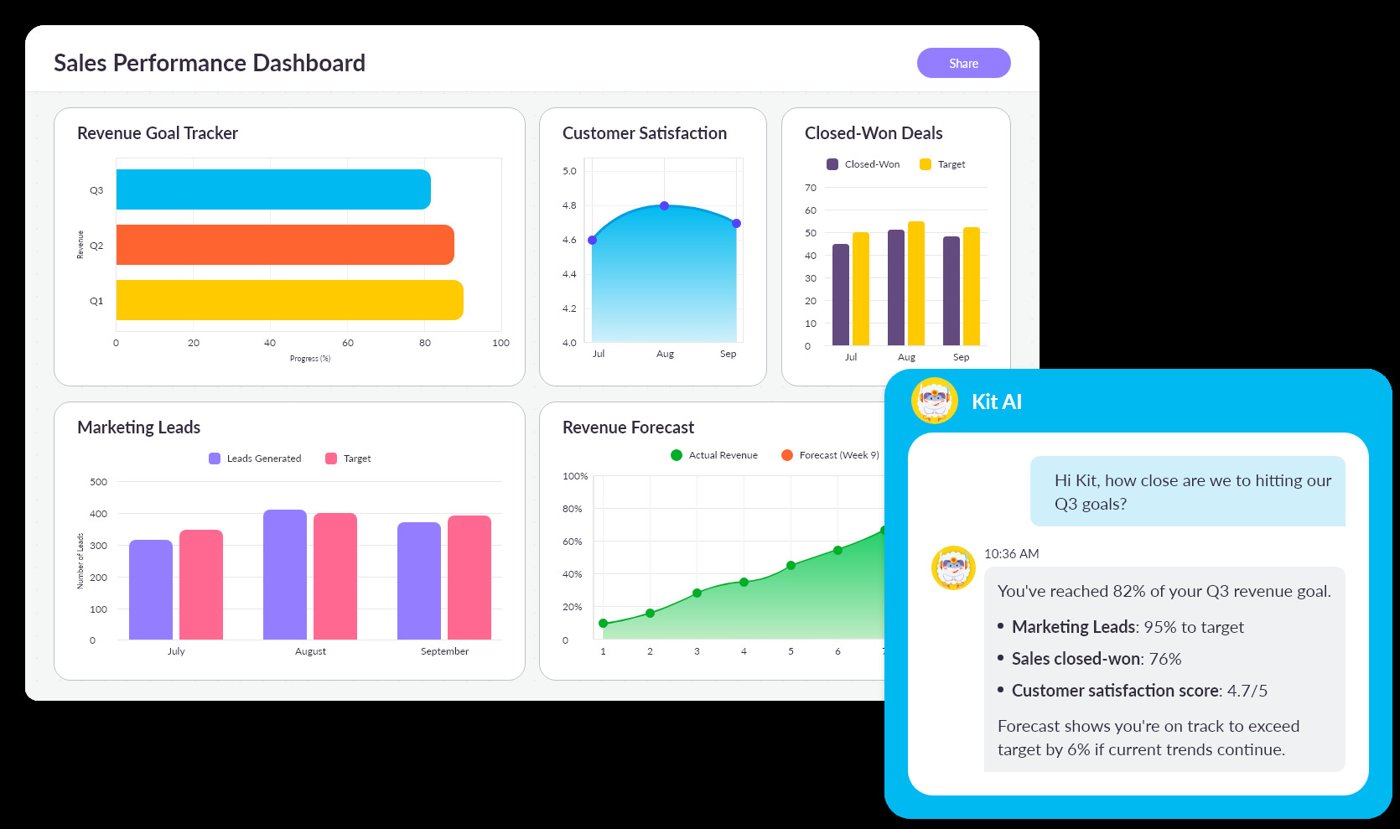
Knit is what Sourcefit calls an operating system for modern work, powered by AI. Its product deck lists HR, accounting, projects, CRM, recruitment and IT helpdesk in one platform, with an AI assistant called Kit.
A dashboard in Knit, with its AI assistant answering a question about Q3 goals. From Sourcefit’s Knit product deck. Image: Sourcefit
SourceCX PulseBI draws on the people data Knit collects, such as training attendance and scores, coaching feedback and schedule adherence. Sourcefit says those signals roll up into a single Pulse Score for each agent, covering predicted performance and risk. PulseBI then joins that score with contact center performance data such as average handle time, customer satisfaction scores and queue times, so the client and Sourcefit can act together on attrition risk or missed coaching before agents leave or performance erodes.
Sourcefit says the idea was working before the product existed. It points to seven years above target on its account with a direct-to-consumer eyewear client. It credits that run to connecting coaching with quality assurance results, scheduling with occupancy and training with customer satisfaction. It describes PulseBI as the system that now makes those connections live.
Andy Schachtel at a Sourcefit tree planting. Photograph: via Andy Schachtel, LinkedIn
Governance built into the system
Sourcefit says it runs AI in production on sensitive client data. Its Fortress announcement centered on the AI governance platform its internal technology team built for that work. In its own announcement, Sourcefit wrote that its controls are part of the system itself. They “are enforced at the database and credential layer before an agent can act.” According to Sourcefit, an AI agent can only retrieve the rows it is authorized to see, and every action is kept on record. Actions that require review still need a person to approve them.
Sourcefit says the platform is aligned to ISO/IEC 42001, the international standard for managing AI responsibly. It also says it has cut the time needed for firewall queries and compliance validation by more than 95%.
What the people doing the work say
The most common uses are writing and documentation (36%), research and analysis (30%) and customer support (14%). The largest barrier people named was limited access to tools (30%), ahead of security concerns (20%). 41% believe AI will support their role without fundamentally changing it.
Your survey found only 7% of your people think AI may cut parts of their role. What would you say to people in the industry who still fear it?
“AI closes the output gap between offshore and onshore teams, making offshore talent even more competitive. What it also doesn't replace is the cultural and social understanding a person brings, and much of AI output still needs humans-in-the-loop. That combination is showing up in the numbers: 68% of our people report real productivity gains from using AI, and 66% feel confident using it daily. People aren't afraid of a tool that's actually making them better at their job.”
Sourcefit volunteers on a company trek to plant trees. Photograph: via Andy Schachtel, LinkedIn
“A provider who can name a recognized standard and prove they meet it is in a different category from one who just says they take AI seriously.”
Andy Schachtel / Founder & CEO, Sourcefit
The buyer question
What to ask a BPO before you sign
What should a buyer ask a BPO to prove about its AI before signing?
“Ask what standard the governance is actually built to. For example, we aligned our platform to ISO/IEC 42001, the international standard for responsible AI management. That standard requires continuous documentation and review, updated as the system actually changes. AI compliance is only tightening, the EU AI Act sets a real bar this year. A provider who can name a recognized standard and prove they meet it is in a different category from one who just says they take AI seriously.”
A buyer can put that same test to Sourcefit. It names ISO/IEC 42001 as the standard its platform is aligned to, which gives the conversation a place to start.
The same idea sits behind the tiers and AI badges in the BPO AI directory. They are earned, so buyers can see that a provider’s readiness has been checked, not claimed.
AI helped draft this article. The BPOAI.ai editorial desk reviewed and edited it, and checked every fact against its original source.
About Andy Schachtel
Andy Schachtel is founder and CEO of Sourcefit, a global outsourcing company.